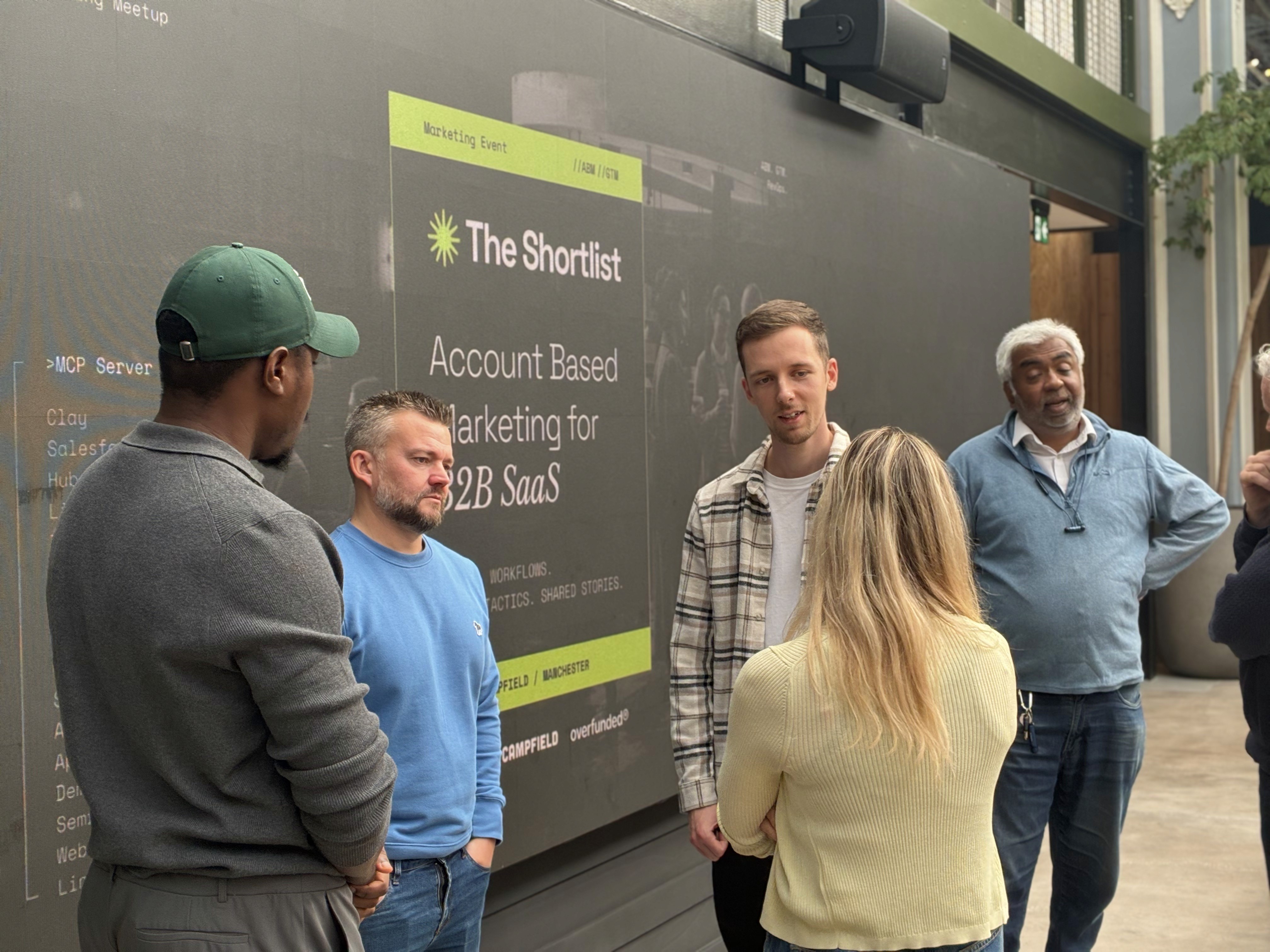

Matt from Tao Digital joined October's Shortlist to talk about AI search. Most of the work is the same as it always was. The new part is being mentioned, and being in the top three.
On Friday 2 October we ran October's Shortlist at Campfield in Manchester. The Shortlist is our monthly Friday-morning session for people who do B2B marketing: one speaker, one subject, a small table and nobody selling anything.
This month's speaker was Matt Tomkin from Tao Digital, a search agency in Bolton that turns ten next year. I asked him to come after hearing him speak in Salford a couple of weeks earlier, because every software founder I work with is asking the same question. Buyers now ask ChatGPT who to buy from. How do we get into the answer?
Matt's answer was calmer than most of what you read online. Most of the work is the same as it always was. A small part is new. These are my notes from his talk and from the questions around the table. The figures are Matt's, from his slides and his own client work.

The short version
Buyers now start with AI. Over half of B2B buyers say they begin their research in an AI chatbot more often than in Google.
Most of the work is unchanged. Roughly 80 to 85% of what gets you recommended by AI is what gets you ranked in Google. The rest is new, and it is mostly being mentioned in press and industry publications.
Top three, not top ten. ChatGPT usually cites about three sources. Google shows ten.
Say the same thing everywhere, and back it with proof.
Nobody can track AI search properly yet.
Leads are rarely the real problem. How fast you answer them matters more.
AI search is one more channel. The goal is still growing the business.
"Be the best that can be in there, be the most authoritative, and you'll win."
Where buyers are doing their research
Matt opened with figures from a recent survey by G2, the software review platform:
51% of B2B buyers start their research in an AI chatbot more often than in Google.
69% chose a different supplier than they had planned because of what an AI told them.
1 in 3 bought from a supplier they had never heard of before the AI named it.
85% think more highly of a supplier when an AI chatbot mentions it.
63% use ChatGPT to start the conversation.
The 69% is the one that worries him most. His view on why people trust the answer: the AI has asked them questions along the way and explained its reasoning, so it feels like advice and not like an advert.
He also kept it in proportion. Around 80% of traffic still comes from Google, and most leads still arrive through websites. About 45% of people who are recommended a business by an AI then go to Google, search for that business and read its website. You cannot get a quote or buy through ChatGPT yet, so the website still closes the sale.
Page one of Google does not mean you show up in ChatGPT
Matt's example was an immigration law firm in Manchester. Over 13 months his agency took them from 5,300 clicks to 10,300, from 326,000 impressions to 1.5 million, and from an average position of 23 (page three) to 7 (page one).
The firm was cited in most of the main AI platforms, except ChatGPT, the one most buyers start with.
I asked why. His answer: ChatGPT generally shows three citations and Google shows ten. Seventh place puts you on page one of Google, where people do scroll past the top three. It does not put you in a three-source AI answer.
Closing that gap is the new part, and it is mentions. Traditional PR.
A PR agency owner at the table had the proof from the other side. A travel client rang to say they were showing up in ChatGPT. His agency does no SEO for them at all. Every source ChatGPT was drawing on was press coverage: travel tips in national newspapers. "We did it by accident," he said.
Links used to be "the gold dust of SEO", Matt said, and they still matter up to a point. If nobody links to you, the search engines and the AI tools will not find you. Once they have found you, the link matters much less. What counts is how often, and how consistently, you are mentioned across different sites and publications.
How long does it take? Matt's estimate is three to six months now, where it used to be six to twelve.
Can you track how you show up in AI?
Software teams always ask "how is our SEO?" and expect a dashboard. I asked what the equivalent is for AI search. Matt's answer was "yes and no", with "a massive pinch of salt".
None of the AI platforms tell you what you show up for. There is no equivalent of Google Search Console.
Bing Webmaster Tools is the exception. It is free and it shows AI data for the Bing side. Bing's AI runs on OpenAI's models, so it works as a rough guide to how ChatGPT sees you.
Google is stable, AI is not. Type a keyword into Google and the same ten sites come back until the next update. An AI writes a fresh answer every time, shaped around the person asking.
Tracking tools disagree with reality. Ahrefs reports one of Matt's clients as number one for their category. When he checks it himself in a private browser window, they are not there.
It is still worth testing your key questions. If a buyer asks an AI about the thing you sell, are you in the answer?
"I don't think there's a silver bullet for tracking AI at the minute, unfortunately."
Google Business Profile matters more than you think
One question from the table: for businesses with a physical location, does a well-kept Google Business Profile help you show up in ChatGPT?
Matt: yes. Open the developer tools in Chrome while ChatGPT answers a local question and you can watch it run a Google search and pull the Google map listing straight through. So the profile carries a lot of weight, "and for B2B businesses as well".
I asked whether there is anything like it for national or global software companies. There is not. The map results work for service businesses with a physical location.
The echo chamber, and how to prove you are the best
A founder at the table raised the problem from the product side. When he asks an AI about his own category, it tells him what he wants to hear. Someone else asking the same thing gets a different answer, and it changes again ten minutes later. "It's becoming more like an echo chamber," he said.
Matt agreed. The AI knows who you are, what you do and why you are asking, from everything you have typed into it. His test: ask your AI assistant what your personality profile is. "It nailed me to a T," he said, and he never knowingly gave it that information. So when you ask it who the best supplier is in your own market, it knows the answer you are hoping for. Your buyers will not get the same result.
What to do about it:
Prove you are the best, the way you always had to. Write content that answers every question a possible buyer has, and put it on your website.
Be consistent everywhere. The AI needs to see the same claim on LinkedIn, in the press and on your site. "If you're anything like me, I don't like saying the same thing twice. But that's what an AI needs."
Back the claim with proof. Links, mentions in publications and real depth on your own site.
"If you've got two pages on your website, one's a service page and one's an about us page, well, you're not the best, are you?"
Another founder summed it up: you cannot pick one channel and expect the AI to treat you as the authority. "There's a lot of plates you need to be spinning."
YouTube
YouTube is one of the sources AI tools cite most. It is the second biggest search engine in the world after Google, and Google owns it. Google now transcribes videos and uses the transcript in its AI answers.
Uploading a video and hoping does not work. The description, timestamps, chapters and tags all need to be right.
Shortcuts for start-ups on a small budget
I asked whether there are shortcuts for early-stage companies that cannot yet afford a PR or SEO agency. There are, Matt said, and you have to be careful with them.
You can send a digital press release to around 100 outlets that appear in Google News for about £100.
Press release wire services such as PR Newswire will get a piece of content onto more platforms than you could reach alone.
For £100 to £200 you will gain some visibility. You will not rank number one on Google.
Follow every shortcut up with quality. Once you can afford to do it properly, do it properly.
Writing with AI without sounding like AI
Do not ask ChatGPT to "write me a blog post on this" and publish what comes out. Google does not mind whether AI wrote it, Matt said. Google minds whether it is good. If people click, find rubbish and leave, Google loses money.
Asked how to hide the fact that AI was involved, he said he would not try. "I just wouldn't cheat. Work with the system."
"Quality will outshine everything else."
His agency records and transcribes every client call, sorts what was said into a library for that client, and writes from it. Drafts pass through three AI stages and then a human editor signs them off. A managing director has their own way of talking about their business, and no hired writer quite matches it. Starting from the client's own spoken words means the result "sounds more human than when a human has written it all".
A method you can copy this week:
Use Claude to research what people are looking for.
Tell it: "Interview me. Give me the questions I need to answer."
Answer out loud with a dictation tool. Matt uses Wispr Flow.
Edit the result. It is built from your answers, so it is in your voice.
PR in a world of fakes
The PR agency owner described what has changed on the press side. "We're almost in a two-tier content world," he said. One tier is the content you produce for search. The other is top-tier media, and it has gone the other way: more human, less automated.
His agency pitched a chief executive to a national journalist. The journalist came back and said they had looked around and did not think she was real. She had almost no digital footprint of her own.
Journalists now want proof the person exists, completely unique stories, and a real conversation. They are going back to the phone. It costs more because it cannot be automated.
The lesson for founders: build your own digital footprint before you need the press.
Attribution: what is working?
In B2B you might have a few thousand named accounts in your CRM. Every school in the UK, for example. Each one is touched by ads, search, social and events. I asked whether you can connect all of that in one place.
You can, Matt said, and it is one of his favourite subjects.
Google Analytics is free, but it credits the last click.
Nobody buys on the first touch. "They buy after six to twelve different touch points, maybe more now, because people are less trusting."
He has watched clients cancel PR because Google Ads "drove the conversion". The ad was the last step. It was not the first, or any of the middle ones.
His agency uses WhatConverts to track phone calls, form submissions and WhatsApp clicks back to where they came from.
HubSpot and Salesforce can do full attribution, at a high monthly cost. With AI you can now build the piece you need for far less.
His favourite model is linear, where every touch gets equal credit. Never last click.
One of the marketers at the table described a familiar headache. A contact is already in the CRM and already gets the newsletter. Marketing then spends £600 on ads to get her to fill in a form, and sales say they already know her. The fixes from the table: exclude people you already have from your ad audiences, and keep a list of who has already been approached so nobody is contacted twice.
A founder made the case for restraint. Too much data leads to paralysis, and to bosses pointing at every number. "How much data is good data?"
Matt's answer: decide what you want out of it first, and build around that.
"The number of times I've been asked about AI search now. It's just a channel. They're all channels. The end goal is building and growing our business."
Making sales glad to see marketing
My last question. At the quarterly meeting, sales turn up with results and marketing turn up with a presentation nobody is excited about. What can marketing bring so that sales look forward to the next campaign?
"Generating enough leads is not the issue. Speed to lead, and managing those leads in the proper way, is the issue."
Salespeople lose patience when a thousand leads arrive and one is any good. Matt's agency builds AI systems that ask the qualifying questions before a person picks the lead up. For a mortgage adviser, leads from social ads cost about £2 each and came in by the thousand, but many were poor. A filter between the form and the sales team fixed two things at once. The lead hears back within minutes, before a competitor gets there. And sales only see people worth calling.
Tools mentioned
Bing Webmaster Tools: the one free place showing AI search data.
Google Search Console: Google's free search data.
Ahrefs: SEO software that also tracks AI citations. Treat with caution.
Google Business Profile: your listing on Google Maps.
G2: source of the buyer research figures.
PR Newswire: press release distribution.
Claude: Matt's first step for research, interviews and prototypes.
Wispr Flow: voice dictation for phone and laptop.
Vercel: hosting for small web apps, where Matt's prototypes go next.
WhatConverts: call and form tracking.
Google Analytics, HubSpot, Salesforce: the usual places attribution is attempted.
One warning from Matt if you start building your own tools: keep your API keys private and set spending limits. A leaked key can run up a large bill over a weekend.
Things to try this month
Ask three AI tools the question your buyer would ask, in a private browser window. Note who appears.
Set up Bing Webmaster Tools.
Check your message matches on your website, your LinkedIn profile and your directory listings.
Write the pages that answer your buyers' real questions.
Get mentioned somewhere that is not your own site: one industry publication, one podcast, one piece of press.
Record your next customer call, with permission, and write your next article from the transcript.
Complete your Google Business Profile, even if you sell to businesses.
Measure how long a new lead waits for a reply. Then halve it.
Stop judging channels on last click.
Thank you to Matt for sharing so openly, and to everyone around the table for the questions.
The Shortlist runs monthly on a Friday morning at Campfield in Manchester. The next one is Friday 6 November, 10 a.m. to 12 p.m. If you work in B2B marketing and would like a seat, sign up here
Let’s keep in touch.
Discover more about high-performance web design. Follow us on Linkedin
