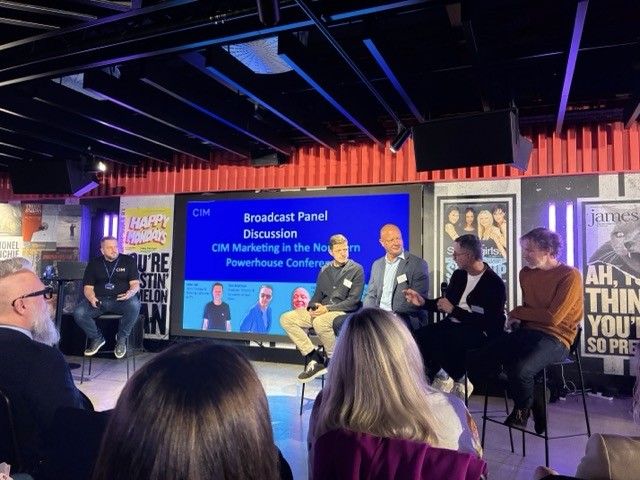

Around two hundred marketers at Co-op Live, most of them selling to millions of people. I sell to companies with a few hundred customers in the whole world. Here is what crossed over.
At about one o'clock on Tuesday, in the Backstage Club at Co-op Live, Mercè Cozens of Think Beyond said twelve marketers in a hundred walk out of the boardroom with the money. That is the sentence I brought home from the Chartered Institute of Marketing's Marketing in the Northern Powerhouse 2026.
The morning sessions were built around people marketing an arena, a new entertainment district, a media campus and broadcast television, most of them selling to audiences in the millions. I run a design agency in Manchester for B2B SaaS companies with a few hundred potential customers in the whole world. I went to see what a room like that knows that I do not. More crossed over than I expected.
CIM North West, the volunteer committee of the Chartered Institute of Marketing for the region, had said around two hundred marketers from across the North would be there. James McCracken, who chairs the committee, opened the second edition and said it was, he believed, the biggest event the venue had hosted since the Brit Awards. Then, after an off-mic prompt, he added that the disco toilet might be the highlight of the day.
Twelve in a hundred
After lunch I stayed in the Backstage Club for Mercè Cozens FCIM, Principal Management Consultant at Think Beyond, on speaking the boardroom language.
"You should never go to battle before you've won the war on paper."
Then three figures, which she said came from several sources. Forty-eight per cent of marketers have a strategic plan that does not match what the board is trying to achieve. Eighty per cent who ask the board for money do not get approval. Eighty-eight per cent never see their budget signed off. Where she landed: out of a hundred marketers, twelve walk out with the money.
Then a story from a sales meeting she had facilitated the week before. One salesperson talked about a pipeline of thirty million against a target of one million. Much of it was not due until 2031. Her reply: "It's all very well that you are thinking beyond, but we are talking about the budget and the output for 2026, not 2031."
Pipeline has to have a date on it.
When your whole market is a few hundred accounts you can name, this should be your advantage. Your pipeline is a list. Every line has a company name, a person, a stage and a quarter. You are not estimating a funnel from traffic. You can say: these forty accounts, these twelve conversations, these three proposals, this quarter. Your customer lifetime value has actual customers in it. Most marketers struggle to produce those numbers. When your market is a few hundred accounts, you can.
She spent longest on the CFO. "The CFO is the custodian of the business. The CFO is not the enemy. They are our best friend because we need to bring them over." What the CFO wants: recurring revenue they can predict, a cost saving, or an advantage that lets the company take revenue from a competitor faster. CFOs do not like spikes and drops. My translation: if the case for a new website is that it will look better, it does not make it past the first conversation.
Her answer on the harder-to-measure work was the 80/20 rule. Build credibility with the 80% you can prove, and the board gets more flexible on the 20% that is harder to quantify. Her example of the 20% was a rebrand. For a company with a named market, the pipeline can be the 80. The website and the positioning sit in the 20, which is the part I sell, so take that with the right amount of salt: prove the 80 first.
Only organisations can create trust
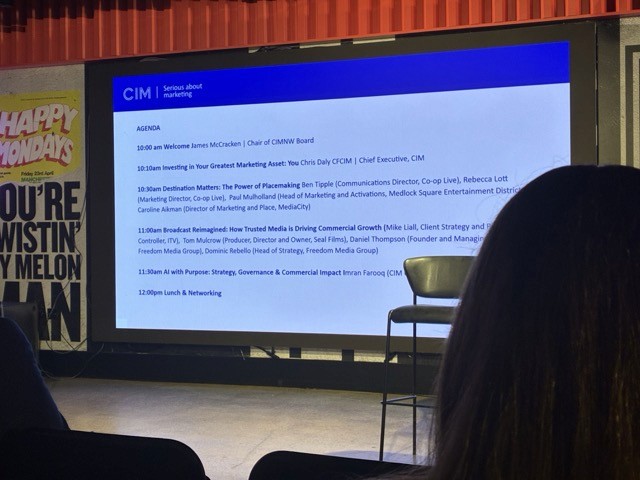
The first talk of the morning was Chris Daly CFCIM, chief executive of the Chartered Institute of Marketing. His frame for the day was three words: smarter, braver, more human.
"While technology can create messages, only organisations can create trust. Trust remains the most valuable brand asset of all and can be easily lost."
The broadcast panel, back for a second year, brought Mike Liall, Client Strategy and Planning Controller at ITV, Daniel Thompson and Dominic Rebello of Freedom Media Group, and Dave from Seal Films, standing in for Tom Mulcrow. Daniel Thompson said broadcast offers "a very safe, very reputable place for brands to flex their muscles and to exist." Mike Liall said trust "actually builds businesses and brands and it can drive profitability", and that attentiveness per second differs a great deal between social and broadcast. For a company selling to a list, I take that as: fewer, deeper touches with the right people matter more than cheap impressions on a feed.

When your market is a few hundred accounts that talk to each other, trust is not a soft metric. Every buyer can pick up the phone and check whether you are who your website says you are.
Change what the name means
The placemaking panel put three venues side by side: Co-op Live, MediaCity and the new Medlock Square Entertainment District. Ben Tipple, Communications Director at Co-op Live, moderated, with Rebecca Lott, Co-op Live's Marketing Director, Paul Mulholland, Head of Marketing and Activations for Medlock Square, and Caroline Aikman, Director of Marketing and Place at MediaCity.
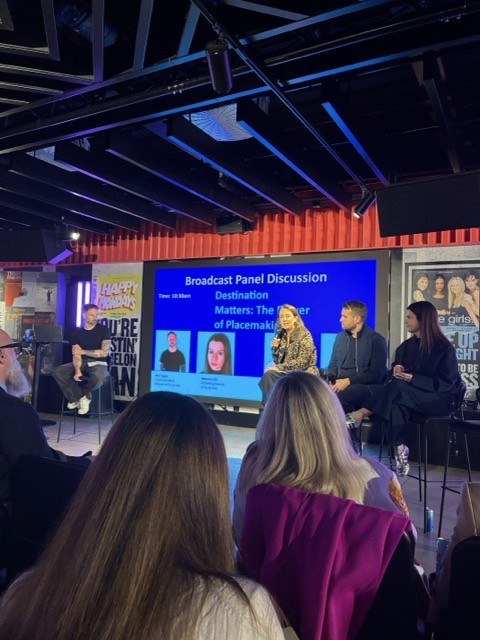
Paul Mulholland told the story of the district's name. It could not be an extension of Manchester City or the Etihad. It had to work for three audiences at once: City fans who have been on that site for the best part of 25 years, visitors who are not fans, and the M11 community around it. They landed on Medlock, the river that runs under the district. Rather than please three groups separately, they found the one thing all three already had in common.
Caroline Aikman took the other route. Research had found people calling MediaCity sterile and corporate. The team considered renaming and decided the name had too much equity to drop. They kept it and changed what it stood for, from property brand to content brand, with a free festival, We Invented the Weekend, bringing over a hundred thousand people to a place the local community had not seen as theirs.
Sometimes you need a new name. More often you need to change what the existing name means.
What you can do now that you could not before
Imran Farooq, CIM Course Director and AI Strategist, had the last slot before lunch. Three trends at once, he said: AI spend is surging, jobs are disappearing, and the return remains hard to find.
His reframe was the useful part. Stop asking how much you are spending on AI. Ask what you can do now that you could not before. Of his eight reasons teams are not ready, I recognised two from most of the SaaS teams I have worked with this year. Tools issued officially, with the ones people actually use running under the radar: how many had been given Copilot, and how many were using Claude or ChatGPT under the table. And no visibility of the return, which leaves cost as the only number anyone argues about.
"It's really important to understand that this dip is the cost of transition. It's the cost of learning."
That was his warning about the J-curve: productivity dips when a team adopts a new tool, and a lot of teams quit in the dip. I was a CTO before this. I recognise that dip from running engineering teams.
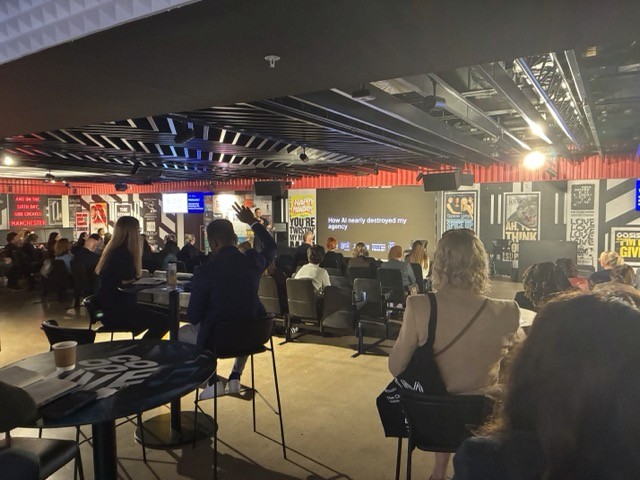
His instruction was to go and look at what the AI says about you. Type the question a buyer would ask about your company into ChatGPT and see what comes back. In my experience the AI mostly repeats what your website says. Where the homepage hedges, so does the answer. Where the positioning is specific, so is the answer.
The brand document
That afternoon I went to the Bentley Record Room for Penelope Silver, AI Strategist, Educator and Founder of Soul Made AI, on the augmented marketer. No slides, no laptop, QR codes on the tables linking to a step-by-step guide. She polled the room. Who has personalised their ChatGPT settings? A few hands. Who has used Projects? Who knows how to create a brand document? Almost nobody. "Oh, okay," she said. "I thought everybody was going to be like this." It was the most practical session I sat in.
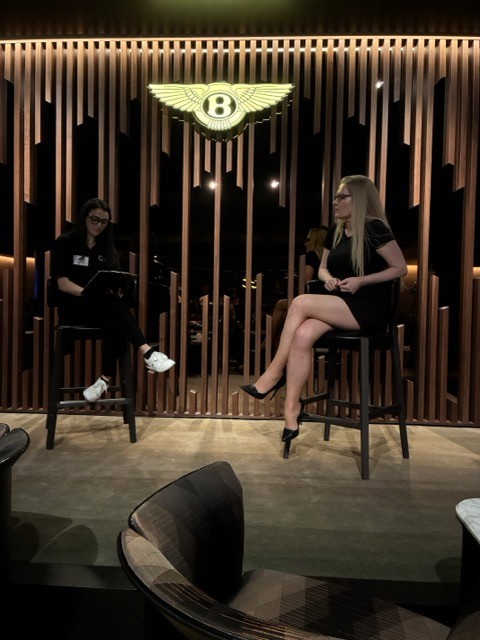
Her rule: do not chase agents, automation or the newest feature until the foundations are solid. The foundation is a brand document loaded into a project. Set up a project in ChatGPT or Claude, one per brand. Upload who the company is, what it does, who it serves, the phrases you would and would not use. She uploads call transcripts so the AI picks up "my actual language, my raw phrasing." Have the AI interview you across about a hundred questions, two hours in short sittings, once. Then every chat in that project starts from your context. "Without that," she said, "it's just going to behave as generic AI."
That brand document is positioning. Who you are for, what you do for them, the words you use and the words you refuse. Most B2B SaaS teams I meet have not written it down, and I suspect that is why their AI output sounds like everyone else's.
Write the document. If you cannot, that is the positioning problem, and no tool will fix it.
Put the judges in the room first
The last breakout I attended was Dr Natasha Clennell, Senior Lecturer at the University of Liverpool Management School, on bridging the gap between marketing theory and practice. She spent 18 years in marketing, including at BBC Television Centre, before her PhD.
What caught me was how she had redesigned the postgraduate marketing programmes. Instead of the usual chain of curriculum and quality boards, she used a sprint approach: about 35 academics alongside students, industry bodies and firms like Liverpool ONE in the room from the first brainstorm. By the final review, "there was essentially nothing major to change."
When the people who will judge the result are few enough to name, put them in the room at the beginning. A company with a few hundred potential customers can do what her university did. A handful of those companies in the room during the first week of work will tell you more than a survey after the website is live.
I see the same gap every week, running the other way. A founder can explain exactly who the company is for in conversation, and none of it is on the website. The knowledge is in the room. It has not made it onto the page.
What I am taking back to work
Put a date on every line of the pipeline. If your market is countable, you can, and it is the number the board wants.
Write the brand document. If you cannot, that is the positioning problem, not a tool problem.
Test the name against all three audiences: the people who already know you, the outsider, and the buyer.
Judge AI on what it lets you do now that you could not before, and hold your nerve through the dip.
Bring a few of the accounts you want into the room before the build, not after the launch.
The twelve marketers in a hundred who walk out with the money are the ones who win the war on paper first. If your market is a list you can name, the paper is already half-written. The question is whether the story you tell the board and the story your website tells the buyer are the same story.
The agenda closed with Jake Third, CEO of Hallam, on the AI shift.
Thank you to James McCracken as Chair, Tamara Rashford, who led the events side, and the CIM North West volunteer committee for putting the Chartered Institute of Marketing's Northern Powerhouse programme together for a second year, and to Co-op Live as headline sponsor, Hallam, Allwag and Disturbance Media for backing the day. Breakouts from Adil Ladha of Autotrader, Dr Marina Hauer and Hitch Marketing ran opposite the ones I chose. Every speaker I heard was generous with specifics. I will be back. The conversation carries on in the CIM Community, North group on LinkedIn.
If you sell to a market you can name, I run The Shortlist, a daytime room for B2B SaaS founders doing the same. The next one is Friday 2 October at Campfield in Manchester.
The Shortlist - October 2, Friday, 10 a.m. - 12 p.m.
https://luma.com/uu4t0z9a
The Shortlist - November 6, Friday, 10 a.m. - 12 p.m.

Let’s keep in touch.
Discover more about high-performance web design. Follow us on Linkedin
